
This article may contain references to products or services from one or more of our advertisers or partners. We may receive compensation when you click on links to those products or services. Nonetheless, our opinions are our own.
The information presented in this article is accurate to the best of our knowledge at the time of publication. However, information is subject to change, and no guarantees are made about the continued accuracy or completeness of this content after its publication date.

Does the stock market and its infinite number of investment choices scare you? Never knowing where to start, what to research, or what to invest in is something that plagues far too many of us.
In fact, according to a study from GoBankingRates, over 9% of people do not invest because they feel they are not knowledgeable enough about the stock market.
For many people, the fear of making the wrong investment decision leads to doing nothing at all. Unfortunately, waiting too long to invest can cost you years of potential growth and compound interest.
The good news is that there is a simple investment instrument that anyone can invest in, regardless of knowledge or skill level:
Index funds.
These are the perfect investment choice for any investor, but they work especially well for beginners who don’t know where to start.
They offer diversification, simplicity, and long-term growth, benefits we’ll dive into below.
What Is an Index Fund?
Now, you’re probably wondering: what exactly is an index fund?
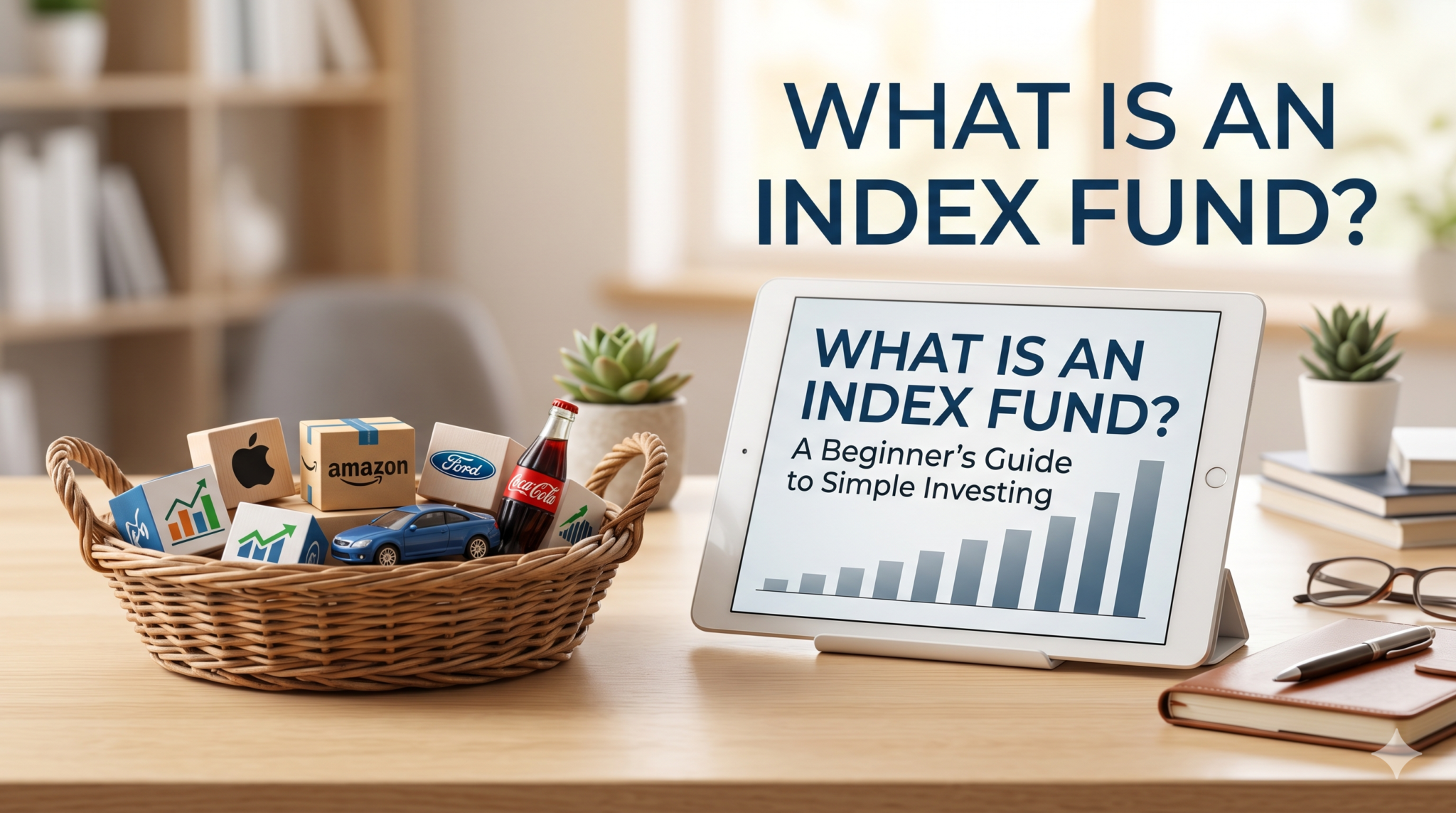
In the simplest terms, an index fund is a pool of investments designed to mimic or track a specific market index.
For example, if you invest in an S&P 500 index fund, you own a small piece of all the companies within the S&P 500.
So instead of investing in just one company by purchasing an individual stock, you can invest your money into an index fund, which in turn buys stocks across all the companies that make up that index.
Some examples of indexes you can invest in include:
- S&P 500 – Composed of the largest 500 U.S. companies
- Dow Jones Industrial Average – A price-weighted index of 30 large publicly traded U.S. companies
- Nasdaq Composite – Over 3,700 stocks spanning technology, consumer services, healthcare, and more
These are just a few examples. As you can see, index funds allow you to invest in a wide range of companies or sectors with a single, simple investment.rom the examples above, you can invest in many different companies or sectors with one simple investment into an index fund.
How Does an Index Fund Work?
An index fund works by mirroring the performance of its chosen index.
If the index goes up, the fund should rise at a similar rate. If the index goes down, the fund will follow.
Additionally, when a stock is added to an index, the index fund buys shares of that stock. When a stock is removed, the fund sells its shares.
Most index funds are passively managed, meaning their sole purpose is to replicate the performance of the index rather than beat it.
So, if the index rises 1% in a day, a passively managed index fund should also rise by roughly 1%, minus a small fee.
Why Are Index Funds So Popular?
There are many reasons index funds have become so popular, but let’s break down the most important ones.
Diversification
One of the biggest advantages is diversification.
Instead of putting your money into a handful of individual stocks, index funds allow you to invest in hundreds, or even thousands, of companies at once.
Let’s say the average investor has $1,000 per month to invest and wants to spread that money across multiple companies.
They could try to buy small amounts of several individual stocks, which might only get them one or two shares in a few companies. Or, they could invest that same $1,000 into an S&P 500 index fund and instantly own a slice of all 500 companies.
This spreads risk across many businesses rather than tying your success to just a few.
In simple terms, it reduces risk. It’s easy for one stock to drop sharply in a single day, but much harder for hundreds of companies to all collapse at once. Some may fall, but others will rise, helping balance things out.
Low Fees
Another major reason index funds are so popular is their low cost.
Because they are passively managed, they don’t require teams of analysts constantly buying and selling stocks. This keeps expenses low, and those savings are passed on to investors.
Typical expense ratios range from about 0.03% to 0.25%.
That means for every $10,000 invested, you might pay just $3 to $25 per year.
And over time, those savings add up significantly.
Simplicity
Index funds are also incredibly simple to understand and research.
Instead of analyzing individual companies, financial statements, and earnings reports, you only need to decide which market or sector you want exposure to.
That simplicity makes it much easier to get started, and stick with it.
Historical Performance
Over long periods, many index funds have outperformed actively managed funds.
For example, the S&P 500 has historically returned an average of about 10% per year since 1926.
That means if you consistently invested month after month over several decades, your money could grow substantially thanks to compounding.
Of course, you might achieve higher returns by picking individual stocks. For example, NVIDIA has experienced massive growth in recent years.
But you can also lose all your money by doing something like this.
That’s why a steady, long-term return of around 10% is so appealing to many investors.
It’s important to remember, though, that this is an average. Some years may see gains of 20%, while others may drop by 10% or more.
Returns are never guaranteed, and there is always risk involved.
Types of Index Funds
As mentioned earlier, there are many different types of index funds available.
Some popular examples include:
- VOO or FXAIX – S&P 500 index funds
- VTI – Total stock market fund
- VXUS – International index fund
- BND – Bond index fund
This is not an exhaustive list, but it gives you a sense of the variety available depending on your goals.
Cons of Index Funds
While index funds offer many advantages, they aren’t perfect. There are a few downsides to consider.
Limited Upside Potential
Because index funds are designed to match the market, they also limit your potential upside.
For example, if you had invested $1,000 in NVIDIA on January 1, 2013, it would have grown to approximately $202,500 today.
If you had invested that same $1,000 into the S&P 500, it would be worth around $17,932.
That’s a significant difference.
However, it’s important to balance that with risk. Individual stocks can deliver massive gains, but they can also go to zero.
Index funds trade extreme upside for stability and consistency.
Market Downturns Still Affect You
Index funds do not protect you from market downturns.
If the overall market declines, such as during a recession, index funds will decline as well.
The key difference is that your losses are spread across many companies rather than concentrated in one.
Using our earlier example: if you invest everything in one company and it fails, you could lose everything.
But if one company fails within an index fund, you still own hundreds of others.
No Control Over Holdings
Another downside is the lack of control.
When you invest in an index fund, you don’t get to choose the individual companies inside it.
You’re buying the entire index, good and bad.
If there’s a company in the index you don’t like, you can’t exclude it.
How to Buy Index Funds
Now that you understand the pros and cons, the next question is: how do you actually invest in index funds?
There are two primary ways:
The first is through an ETF (Exchange-Traded Fund), which trades like a stock and fluctuates in price throughout the day.
The second is through a mutual fund, which is priced once per day after the market closes.
To invest in either, you’ll need to open a brokerage or retirement account with a firm such as Charles Schwab, Fidelity, or Vanguard.
Once your account is set up, you can begin purchasing index funds just like you would buy stocks.
Who Should Invest in Index Funds?
Index funds can benefit many types of investors, but they are especially useful for the following groups:
Beginners – They remove complexity, reduce the need for research, and lower overall risk.
Hands-off investors – Perfect for those who prefer a “set it and forget it” approach.
Long-term investors – Ideal for people focused on consistent investing over years or decades, allowing compounding to work in their favor.
Conclusion
Index funds are powerful investment tools that combine simplicity, diversification, and long-term growth potential.
They aren’t flashy, and they won’t always deliver the highest possible returns, but they offer a reliable path to building wealth over time.
If you’re intimidated by the stock market or unsure where to begin, index funds are one of the best places to start.
Sometimes, the simplest strategy is the one that works best.
Sean writes about practical strategies to build wealth and simplify money decisions at Simplifying Personal Finance or on X. He focuses on long-term wealth building, financial goal setting, paying down debt, and couples finances.
Voted "Best Overall Budgeting App" by Forbes and WSJ
Monarch Money helps you budget, track spending, set goals, and plan your financial future—all in one app.
Get 50% OFF your first year with code MONARCHVIP


Recommended Reads
- Cloud Computing Bootcamp: Is It Worth the Investment for Your Tech Career? Career
- Financial Personality: How Your Enneagram Type Influences Your Spending Habits Beginner's Guides
- Remote Coding Bootcamp: Learn to Code from Anywhere Career
- Beginner's Guide to S&P 500 Index Funds: Unlocking the Power Beginner's Guides
- How to Score Big Discounts on Apple Black Friday Deals: Online Shopping Tips Deals
- How to Decide Between SoFi vs Acorns for Investing Investing
- How to Find the Cheapest Flights: CheapOair vs Skyscanner Travel
- Crypto Fear and Greed Index: Key Facts to Understand Beginner's Guides
- Index Funds: How to Grow Your Wealth with Just 0.05% Fees and 8% Returns Beginner's Guides
- Digital Marketing and Social Media Marketing: How to Use Both for Success Business

Reviewed and edited by Albert Fang.
See a typo or want to suggest an edit/revision to the content? Use the contact us form to provide feedback.
At FangWallet, we value editorial integrity and open collaboration in curating quality content for readers to enjoy. Much appreciated for the assist.
Did you like our article and find it insightful? We encourage sharing the article link with family and friends to benefit as well - better yet, sharing on social media. Thank you for the support! 🍉
Article Title: What Is an Index Fund? A Beginner’s Guide to Simple Investing
https://fangwallet.com/2026/05/12/what-is-an-index-fund-a-beginners-guide-to-simple-investing/The FangWallet Promise
FangWallet is an editorially independent resource - founded on breaking down challenging financial concepts for anyone to understand since 2014. While we adhere to editorial integrity, note that this post may contain references to products from our partners.
The FangWallet promise is always to have your best interest in mind and be transparent and honest about the financial picture.
Become an Insider
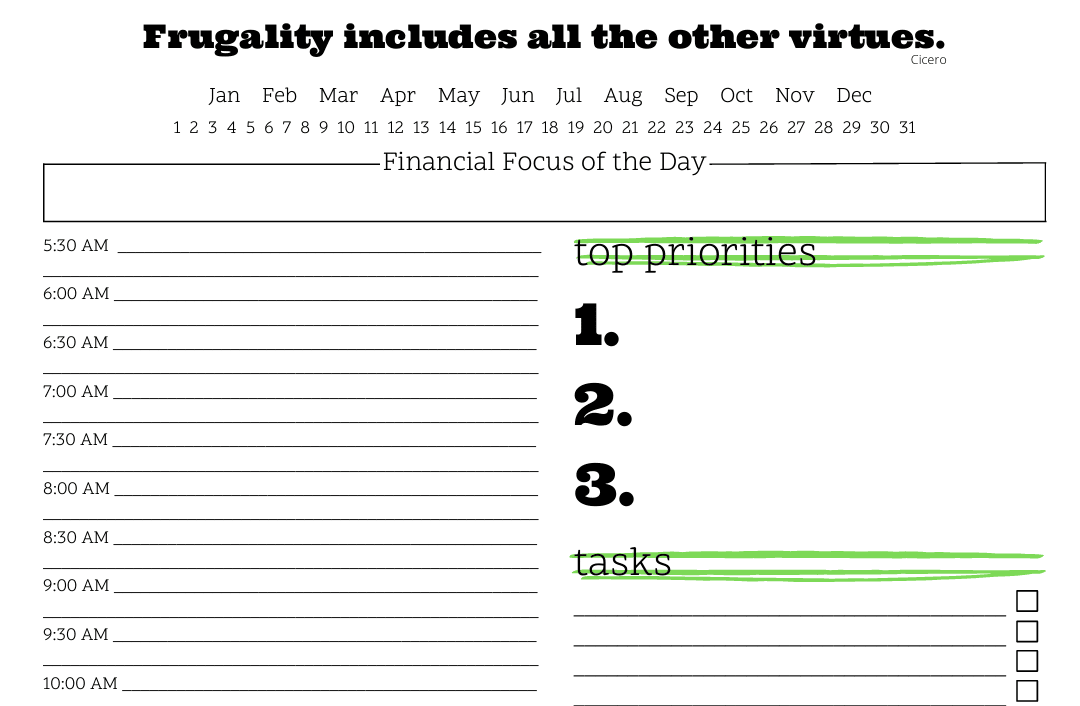
Subscribe to get a free daily budget planner printable to help get your money on track!
Make passive money the right way. No spam.
Editorial Disclaimer: The editorial content on this page is not provided by any of the companies mentioned. The opinions expressed here are the author's alone.
The content of this website is for informational purposes only and does not represent investment advice, or an offer or solicitation to buy or sell any security, investment, or product. Investors are encouraged to do their own due diligence, and, if necessary, consult professional advising before making any investment decisions. Investing involves a high degree of risk, and financial losses may occur including the potential loss of principal.
Source Citation References:
+ Inspo
There are no additional citations or references to note for this article at this time.