
This article may contain references to products or services from one or more of our advertisers or partners. We may receive compensation when you click on links to those products or services. Nonetheless, our opinions are our own.
The information presented in this article is accurate to the best of our knowledge at the time of publication. However, information is subject to change, and no guarantees are made about the continued accuracy or completeness of this content after its publication date.

Finding the right insurance in Dallas, Texas feels a lot like navigating the Mixmaster interchange during Friday evening rush hour. It is fast, slightly chaotic, and one wrong lane choice can cost you a lot of time and money. Dallas has a unique economic and geographic footprint, which means generic insurance advice you find online rarely fits the realities of living here. Whether you are protecting a home in Plano, insuring a commuter vehicle for the daily drive down Interstate 635, or looking for health coverage that includes major local medical centers, standard policies require a closer look.
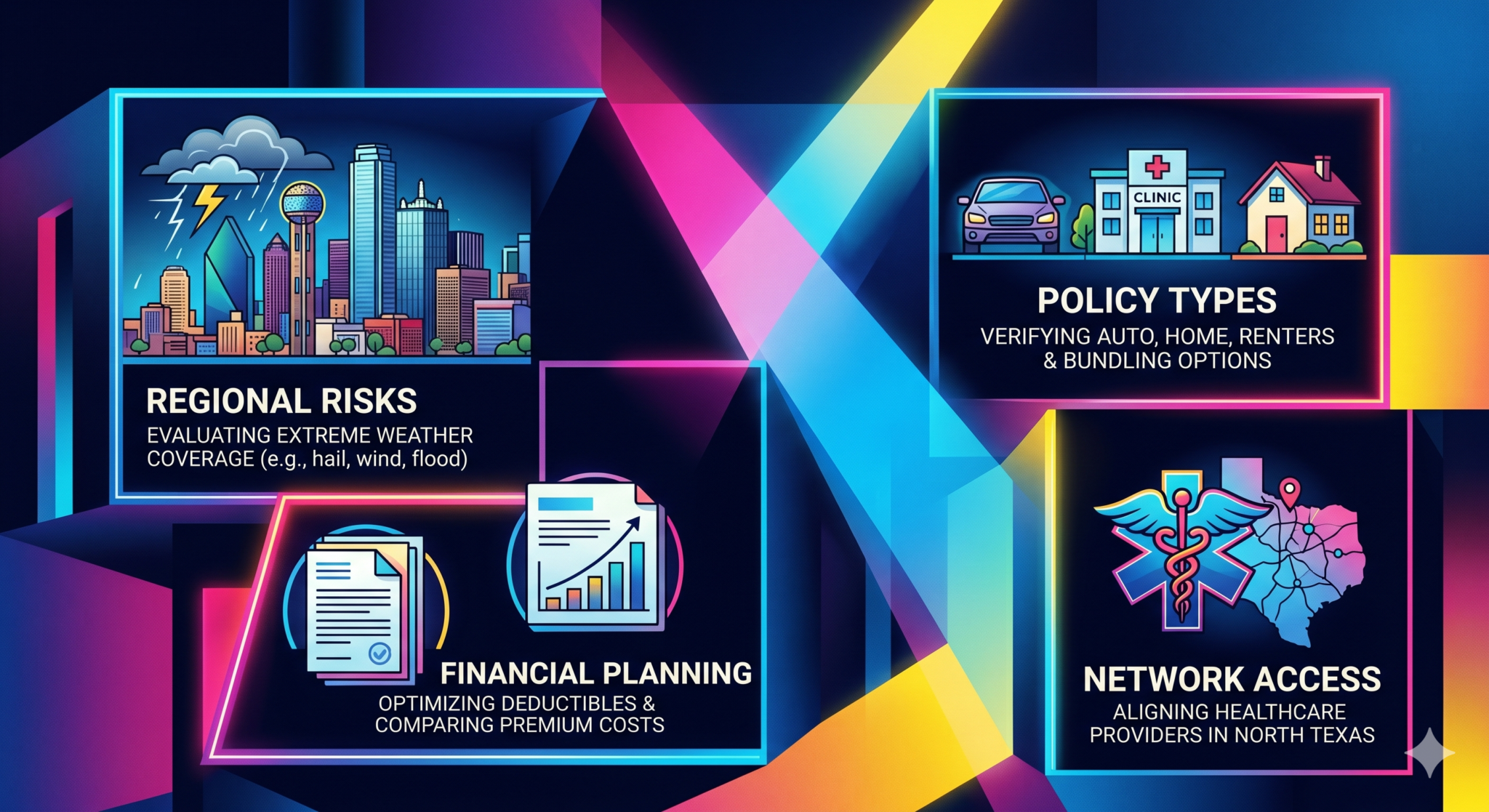
Taking an analytical approach helps unpack how regional quirks impact coverage needs and costs. Stripping away the marketing jargon reveals several fundamental factors that dictate what a solid policy looks like in the Dallas-Fort Worth metroplex.
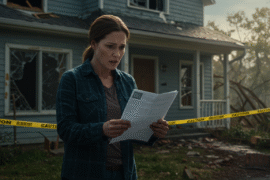
The local climate dictates property insurance rules in Texas. Dallas sits right at the bottom edge of Tornado Alley and experiences severe convective storms, a technical term for weather systems that create violent winds, massive downpours, and softball-sized hail.
When you look at a homeowners or auto policy in Dallas, the wind and hail sections deserve the most scrutiny. Many national carriers have altered how they handle storm damage in North Texas due to massive payout losses over the last few years.
A standard policy in milder states might feature a flat $1,000 deductible, which is the amount you pay out of pocket before insurance kicks in. In Dallas, almost every carrier uses a percentage-based deductible for wind and hail damage. These deductibles typically range from 1% to 2% of the home’s total insured value, not the cost of the damage itself.
The Math in Practice: If a house is insured for $450,000 and a severe spring storm shreds the roof, a 2% wind and hail deductible means the homeowner must pay $9,000 out of pocket before the insurer provides a single dollar for repairs.
Balancing that out-of-pocket exposure against a monthly premium requires clear financial trade-offs. Choosing a lower percentage deductible reduces immediate financial shock after a storm but raises monthly fixed costs significantly.
Auto Insurance and the Metroplex Commute
Driving in Dallas involves covering massive distances at high speeds, often alongside thousands of other commuters. Long drive times on major arteries like the Dallas North Tollway or Highway 75 increase the statistical probability of an accident.
Texas regularly ranks high for the number of uninsured or underinsured motorists on the road. State law requires drivers to carry liability insurance to pay for damage they cause to others, but a substantial percentage of drivers ignore that rule or carry only the bare minimum legal limits.
Opting for basic liability coverage leaves a massive gap in protection. If an underinsured driver hits a vehicle, the innocent party can end up facing massive medical bills and repair costs alone. Uninsured/Underinsured Motorist (UM/UIM) coverage acts as a personal safety net, stepping in to cover what the at-fault driver cannot pay.
Comprehensive coverage also shifts from an optional add-on to a necessity in the region. Comprehensive insurance covers damage caused by things other than collisions. In Dallas, that primarily means hail damage and cracked windshields from highway debris. A single severe storm can easily dent every panel on a vehicle, totaling an otherwise perfect car purely through cosmetic damage.
Featured: Seguro de auto en Dallas
The Changing Landscape of Provider Solvency
The Texas insurance market is undergoing a major shift. Several prominent insurance groups have scaled back operations, stopped writing new policies, or pulled out of the state entirely because the cost of paying out claims from weather disasters has outpaced premium revenue.
A shrinking pool of insurance companies creates an environment with less competition and higher prices. When evaluating an insurance company, checking financial strength ratings from independent agencies like A.M. Best becomes highly useful. A company boasting cheap rates does little good if the business lacks the capital reserves to pay out claims quickly after a widespread regional disaster.
Relying on an independent insurance broker rather than a captive agent who represents only one brand often yields better results. Independent brokers possess the ability to shop across dozens of regional and national carriers simultaneously to locate companies still actively competing for North Texas business.
Health and Life Insurance Network Realities
The DFW area boasts world-class medical facilities, including major institutions like UT Southwestern Medical Center and the Baylor Scott & White network. However, having great hospitals nearby matters very little if a health insurance policy excludes them.
The choice between a Health Maintenance Organization (HMO) and a Preferred Provider Organization (PPO) carries immense weight in the local market. HMOs generally require referrals from a primary care doctor to see specialists and limit care strictly to a tight network of providers. PPOs offer much broader flexibility, allowing patients to see out-of-network doctors, though at a higher cost.
Because local hospital systems are expanding and consolidating rapidly, networks change often. Checking that preferred doctors and local emergency rooms sit firmly within a plan’s active network before enrolling protects against unexpected, thousands-of-dollars medical bills later.
A Strategic Framework for Comparing Policies
Navigating these choices requires a systematic approach to comparison rather than simply picking the lowest monthly price. The optimal strategy treats insurance as a mechanism to transfer risks that would otherwise cause financial ruin, while retaining smaller risks that are manageable out of pocket.
| Factor | What to Look For | The Dallas Context |
| Deductible Structure | Separate wind/hail percentages vs. flat fees | Look for a separate deductible that does not exceed 1% if cash reserves are low. |
| Auto Uninsured Coverage | UM/UIM bodily injury and property damage limits | Match these limits to the total value of personal assets to prevent lawsuits. |
| Policy Endorsements | Replacement cost vs. Actual Cash Value (ACV) for roofs | ACV factors in depreciation, meaning an old roof yields a tiny payout. Always look for replacement cost. |
| Network Alignment | Direct participation of major DFW hospital groups | Confirm that regional trauma centers near your home or work count as in-network. |
Finalizing a Coverage Plan
Developing a resilient insurance portfolio in Dallas involves reviewing policies annually. Because the local market changes rapidly, a policy that offered the best value two years ago might now feature inflated rates or reduced coverage limits.
Reviewing policy documents during calm seasons avoids the stress of discovering coverage gaps in the middle of a claims crisis. Prioritizing robust deductibles, verifying network access, and protecting against uninsured risks builds a financial shield capable of withstanding both turbulent local weather and unexpected market shifts.
Voted "Best Overall Budgeting App" by Forbes and WSJ
Monarch Money helps you budget, track spending, set goals, and plan your financial future—all in one app.
Get 50% OFF your first year with code MONARCHVIP


Recommended Reads
- Digital Marketing and Social Media Marketing: How to Use Both for Success Business
- Acorns vs Wealthfront 2025-2026: Which Robo-Advisor is Best? Investing
- Remote Coding Bootcamp: Learn to Code from Anywhere Career
- Lemonade vs GEICO: Which Renters Insurance is Best? Insurance
- Mission Lane Visa: Your Key to Financial Freedom Credit Cards
- How to Choose: Priceline vs CheapOair for Best Airfare Deals Travel
- Beginner's Guide: Working for Uber vs. Lyft - Pros & Cons in 2025 Make Money
- Poppins Payroll vs SurePayroll Review Comparison (2025-2026): Pros and Cons Reviews
- How to Prepare for the Best Black Friday and Cyber Monday Deals in 2025 Deals
- Loans Like Upstart: Alternatives Worth Checking Out Beginner's Guides

Reviewed and edited by Albert Fang.
See a typo or want to suggest an edit/revision to the content? Use the contact us form to provide feedback.
At FangWallet, we value editorial integrity and open collaboration in curating quality content for readers to enjoy. Much appreciated for the assist.
Did you like our article and find it insightful? We encourage sharing the article link with family and friends to benefit as well - better yet, sharing on social media. Thank you for the support! 🍉
Article Title: Key Factors to Consider When Choosing Insurance in Dallas, TX
https://fangwallet.com/2026/06/02/key-factors-to-consider-when-choosing-insurance-in-dallas-tx/The FangWallet Promise
FangWallet is an editorially independent resource - founded on breaking down challenging financial concepts for anyone to understand since 2014. While we adhere to editorial integrity, note that this post may contain references to products from our partners.
The FangWallet promise is always to have your best interest in mind and be transparent and honest about the financial picture.
Become an Insider
Subscribe to get a free daily budget planner printable to help get your money on track!
Make passive money the right way. No spam.
Editorial Disclaimer: The editorial content on this page is not provided by any of the companies mentioned. The opinions expressed here are the author's alone.
The content of this website is for informational purposes only and does not represent investment advice, or an offer or solicitation to buy or sell any security, investment, or product. Investors are encouraged to do their own due diligence, and, if necessary, consult professional advising before making any investment decisions. Investing involves a high degree of risk, and financial losses may occur including the potential loss of principal.
Source Citation References:
+ Inspo
There are no additional citations or references to note for this article at this time.